

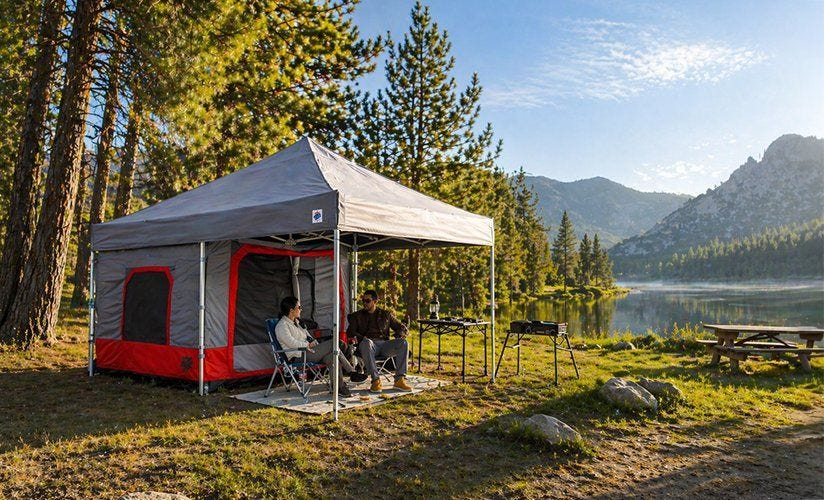
There is a version of this question that has a clean answer and a version that does not. The clean answer is…traditional tents are for sleeping, canopy tents are for everything else. The real answer is more useful than that.
They Are Not Competing Products
This is the part most comparisons get wrong.
A traditional camping tent is a sleep shelter. Enclosed floor, walls, ceiling, zipper door. It holds heat, keeps insects out, and gives you a dry place to spend the night when the temperature drops. That is the job it was designed for.
A canopy tent for camping is a living space. Open or semi-open, roof and frame, built to cover a table and chairs and the six people sitting around them. Some versions close fully with sidewall attachments. Some stay open on all sides. Neither one is trying to replace the other.
The campers who get the most out of both are the ones who stop thinking of it as a choice.
The Situations Where a Canopy Tent Wins
Car camping, full stop. When you are not carrying anything on your back, weight and pack size stop being factors, and a canopy tent adds something a traditional tent genuinely cannot… shared space. A large canopy tent for group camping with walls turns a campsite into an actual place to hang out. Table underneath it, chairs, food, all of it covered. Rain starts and nobody has to scatter.
Group trips are the obvious use case. Six or more people at a site need somewhere to sit together that is not everyone crowding into a sleeping tent. A 10x20 with sidewalls attached gives you a communal room that works morning through night.
Day camping and festival setups are another one. If the goal is shade, a gathering point, and some protection from light rain, a pop up canopy tent for camping handles it faster and with less effort than any traditional setup.
The Situations Where a Traditional Tent Wins
Cold nights. Full stop on this one too.
A low ceiling enclosed tent traps body heat in a way that no canopy structure matches, even with all the sidewalls on. If you are camping in October in the mountains or anywhere that gets genuinely cold overnight, your sleep shelter needs to be a proper tent.
Backpacking is not even a discussion. Carrying a canopy frame any real distance does not make sense. Portable camping tent pop up designs built for backpacking exist because weight is the constraint, and a canopy frame is not the answer there.
Solo camping where you just need a place to sleep and store gear, same thing. A traditional tent is the right tool.
The Option That Covers Both
A canopy tent that converts to an enclosed tent is the practical middle ground that most group campers end up wanting once they have done a few trips.
Our shelters work exactly this way. Run open sides during the day when the weather is good and people are moving in and out. Zip the sidewalls on at night or when rain picks up and the space closes completely. It is not a replacement for a sleeping tent in a serious cold, but for three season camping it handles most of what a group actually needs from a shelter.
The canopy tent with full enclosure for outdoor camping also gives you something a sleeping tent never will..room to actually stand up, move around, and share a meal without everyone sitting on top of each other.
Fire Resistance Is Worth Bringing Up
Campfires and tent fabric are a combination that deserves attention.
If your camping setup puts a canopy anywhere near a fire pit, and most campsite layouts do, a fire resistant camping canopy is the sensible choice. Our canopy tops are available in flame resistant materials that meet NFPA 701 standards. Sparks travel farther than people expect and the difference between a certified top and a standard one is not something you want to find out the hard way on a camping trip.
Size for a Camping Setup
A 10x10 is enough for a small group or a personal setup. Fits a table and four chairs, sets up in a few minutes, goes back in one bag. If your campsite is tight or you are going with two or three people, this is where to start.
A 10x20 is for group trips where people actually gather. Room for a full table, multiple chairs, a cooking area, and people moving around without squeezing past each other. With sidewalls zipped on it stops feeling like a tent and starts feeling like an outdoor room.
A Few Things Before You Set Up
Check the campground rules first. Some sites have restrictions on canopy structures, size limits, or placement rules relative to fire rings and neighboring spots. Worth knowing before you unload.
Stake every leg regardless of the forecast. Campsite conditions change overnight and a canopy that is not anchored properly becomes a real problem at 3AM when the wind picks up. Stakes on soft ground, weight bags on compacted surfaces.
FAQs
What is the best canopy tent for family camping?
Our Eclipse with full sidewalls is what most families land on. Open during the day for a shared space, closed at night or in rain. Fits everything a family group needs under one roof.
Can you camp in a canopy tent?
With sidewalls fully attached, yes. For mild three season nights it works as a complete shelter. For cold camping it is much better used as a communal space with a sleeping tent alongside it.
Are canopy tents better than traditional tents for camping?
For group living space and day use, a canopy tent is hard to beat. For sleeping in cold conditions or carrying gear on your back, a traditional tent is the right call. Most campers who camp regularly end up using both.
Are canopy tents warmer than traditional tents?
No and this matters if you are camping in cold weather. Even a fully enclosed canopy with sidewalls does not hold heat the way a low ceiling sleeping tent does. Plan accordingly.
Is a canopy tent waterproof enough for camping?
Our canopy tops use coated fabric that handles rain well in typical three season conditions. Sidewalls on means the inside stays dry through most weather. For sustained heavy storms a dedicated camping tent is still the stronger option.
What size canopy do I need for camping?
Small group or personal setup, a 10x10 is plenty. Six or more people who want a real communal space with room to move, go 10x20 and you will not feel like you are cramming everyone in.