

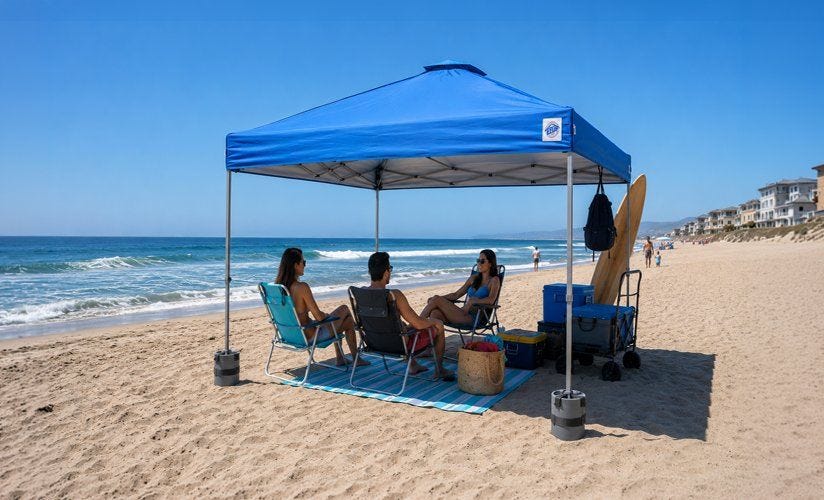
Le sol sablonneux n'offre presque aucune adhérence et le vent côtier se lève sans crier gare. La bonne nouvelle, c'est qu'ancrer correctement votre tente à baldaquin instantanée prend environ dix minutes de préparation supplémentaires et cela fait la différence entre une tente qui reste en place toute la journée et une qui devient un danger pour tout le monde aux alentours.
Pourquoi la plage rend-elle l'ancrage de la tente plus difficile?
L'herbe et l'asphalte offrent aux piquets quelque chose de solide dans lequel s'accrocher. Ce n'est pas le cas du sable. Le sable sec et meuble se déplace constamment et un piquet standard se retire avec presque aucune résistance dès qu'une rafale survient.
Les régimes de vent côtiers se comportent également différemment des conditions intérieures. Une matinée calme peut se transformer en rafales de 32 km/h en milieu de journée avec très peu d'avertissement. Une tente à baldaquin instantanée robuste qui semble parfaitement stable lors de l'installation peut commencer à se soulever par les pieds arrière quelques heures plus tard si elle n'est pas correctement ancrée dès le départ.
Ce qui fonctionne réellement sur le sable
Les sacs de sable sont votre première ligne de défense
Les sacs de sable sont l'outil d'ancrage le plus pratique pour la plage car vous les remplissez sur place en utilisant le sable juste sous vos pieds. Pas de poids supplémentaire à transporter jusqu'à la plage et aucun outil spécial nécessaire. Accrochez-en un à chaque pied de votre tente à baldaquin instantanée à l'aide des boucles ou des sangles du sac.
Pour une installation standard de 10x10, visez 25 à 40 livres par pied. Si vous utilisez une tente à baldaquin instantanée de taille commerciale 10x20 sur un marché de vendeurs de plage ou lors d'un événement en plein air, poussez cela à au moins 40 livres par pied. Plus la surface du baldaquin est grande, plus elle prend le vent et plus vous avez besoin de poids pour la contrer.
Les piquets à vis pour sable remplacent les piquets de sol standards
Les piquets de tente ordinaires sont inutiles sur une plage. Les piquets à vis pour sable sont conçus spécifiquement pour cette surface. Ce sont de longues ancres en spirale que l'on enfonce profondément dans le sol plutôt que de marteler directement. La forme de la tarière s'accroche dans le sable et tient même lorsque les conditions deviennent difficiles.
Utilisez des vis d'au moins 30 cm et attachez des haubans de chaque pied d'angle vers l'extérieur à un angle de 45 degrés. Cette traction latérale empêche votre baldaquin de vaciller d'un côté à l'autre dans le vent. Ces piquets sont particulièrement utiles lorsque vous installez la meilleure grande tente à baldaquin pour les groupes où la stabilité sur un cadre plus large est importante.
Découvrez notre collection de tentes à baldaquin instantanées robustes pour trouver des options de cadre conçues pour fonctionner avec des installations d'ancrage de plage appropriées.
Comment positionner la tente avant que le vent ne frappe
La direction dans laquelle votre tente est orientée modifie la charge que le vent exerce sur le cadre. Dirigez le côté le plus court directement dans le vent plutôt que le long côté ouvert. Cela réduit la surface sur laquelle le vent pousse et diminue la contrainte sur chaque point d'ancrage.
Abaissez toujours votre tente à sa hauteur minimale lorsque les rafales se lèvent. Une tente plus haute attrape beaucoup plus d'air. La plupart des cadres de tentes à baldaquin instantanées offrent au moins deux options de hauteur, donc l'ajustement prend quelques secondes.
Retirez les parois latérales ou ne gardez que le panneau au vent en place avec toutes les aérations ouvertes. Une paroi latérale fermée agit comme une voile et exerce une énorme pression sur l'ensemble du cadre.
Scénario d'installation réel : Marché de vendeurs de plage
Un vendeur installant une tente à baldaquin instantanée commerciale 10x20 sur un marché de plage le samedi est confronté à un vent de 18 mi/h en fin de matinée. Les pieds arrière commencent à se soulever. La solution est quatre sacs de sable remplis sur chaque pied, des piquets à vis pour sable à chaque coin avec des haubans tendus vers l'extérieur, et la tente abaissée à mi-hauteur avec les panneaux latéraux retirés.
Cette approche superposée maintient la structure stable pour le reste de l'événement. Résoudre cela avant l'arrivée du vent est toujours plus facile que de ré-ancrer en plein événement avec des clients qui attendent.
Pour les vendeurs à la recherche de la bonne taille et structure pour les marchés et événements en plein air, parcourez la collection de tentes à baldaquin E-ZUP et lisez notre guide sur le choix de la bonne taille de tente à baldaquin pour votre événement avant votre prochaine installation.
Conseils rapides pour faire ses bagages et se préparer avant de partir
Quelques choses à faire avant de quitter la maison :
- Apportez des sacs de sable vides à remplir conçus pour les sacs de poids de baldaquin. Ils prennent moins de deux minutes à remplir sur n'importe quelle plage.
- Emballez au moins quatre piquets à vis pour sable et des haubans supplémentaires. Les piquets standard restent à la maison.
- Vérifiez les prévisions de vent le matin de votre événement pour votre emplacement exact sur la plage.
- Des vents supérieurs à 40 km/h signifient que vous démontez la tente plutôt que d'essayer de la combattre.
- Ne laissez jamais votre tente sans surveillance une fois que le vent se lève, même si elle semble stable.
Conclusion
Sécuriser une tente à baldaquin instantanée à la plage consiste à superposer votre ancrage plutôt que de compter sur une seule méthode. Des sacs de sable sur chaque pied combinés à des piquets à vis pour sable et des haubans vous offrent la prise la plus fiable sur toute surface sablonneuse. Positionnez le baldaquin bas avec l'extrémité étroite face au vent et retirez les parois latérales lorsque les rafales arrivent. Que vous soyez là pour une journée en famille ou que vous organisiez une installation de vendeur, ces étapes maintiennent votre tente à baldaquin instantanée robuste en sécurité et debout du matin au soir.
Parcourez la gamme complète des E-ZUP Eclipse® conçues pour une utilisation en extérieur afin de trouver un cadre prêt à affronter tout ce que la plage lui réserve.
Foire aux questions
Comment empêcher un auvent escamotable de s'envoler?
Utilisez des sacs de sable sur chaque pied de votre tente à baldaquin instantanée et ajoutez des piquets à vis pour sable à chaque coin avec des haubans. Abaisser la hauteur du baldaquin et faire face à l'extrémité étroite au vent réduit également considérablement la force qui frappe votre tente à baldaquin instantanée robuste.
Comment ancrer un auvent escamotable sur une plage?
Enfoncez des piquets à vis pour sable profondément dans le sable à chaque coin et attachez des haubans vers l'extérieur à un angle de 45 degrés. Associez-les à des sacs de sable remplis sur chaque pied car les piquets standard n'offrent presque aucune adhérence sur le sable meuble, quelle que soit la taille du baldaquin.
Comment ancrer un auvent dans le vent?
Abaissez immédiatement votre tente à baldaquin instantanée à sa hauteur la plus basse et retirez toutes les parois latérales afin que l'air circule librement. Sécurisez les quatre pieds avec des sacs de sable et ancrez les coins avec des ancres en spirale avant que le vent ne se lève plutôt qu'après.
Comment maintenir un auvent escamotable?
Remplissez des sacs de sable sur place et accrochez-en un à chaque pied de votre tente à baldaquin instantanée à l'aide des boucles intégrées. Pour les installations plus grandes comme une tente à baldaquin instantanée de taille commerciale 10x20, augmentez le poids par pied à au moins 40 livres et utilisez toujours des piquets à vis pour sable en plus des sacs pour une tenue complète.