
Most people shopping for a canopy tent focus on size, color, or price. Fabric specs, if they're noticed at all, tend to be a footnote. But that "500D" or "300D" listed on the product page is telling you something important about how long that tent will actually hold up at an outdoor market, a trade show booth, or a weekend event.
The number to know is denier. Understanding what it means, and why 500D has become the professional-grade benchmark, can save you from buying a tent that looks great on day one and falls apart by mid-season.
What Is Denier Rating, and Why Does It Matter for Canopy Fabric?
Denier (D) measures the thickness of the individual threads woven into a fabric — specifically, the mass in grams of 9,000 meters of a single fiber. The higher the denier, the thicker and tougher the yarn.
That directly affects:
- Tear resistance
- Abrasion resistance
- Overall structural durability
- How crisp and vibrant printed graphics look on the surface
You may occasionally see GSM (grams per square meter) referenced too; it measures overall fabric weight rather than yarn thickness. It's a useful secondary data point, but denier is the number that actually predicts how a canopy fabric performs outdoors, and it's the spec used across the US canopy tent market, including by E-Z UP.
Denier by the Numbers: 150D, 300D, 500D, and 600D
Not every canopy needs the same fabric. Denier scales roughly with how often and how hard a canopy gets used:
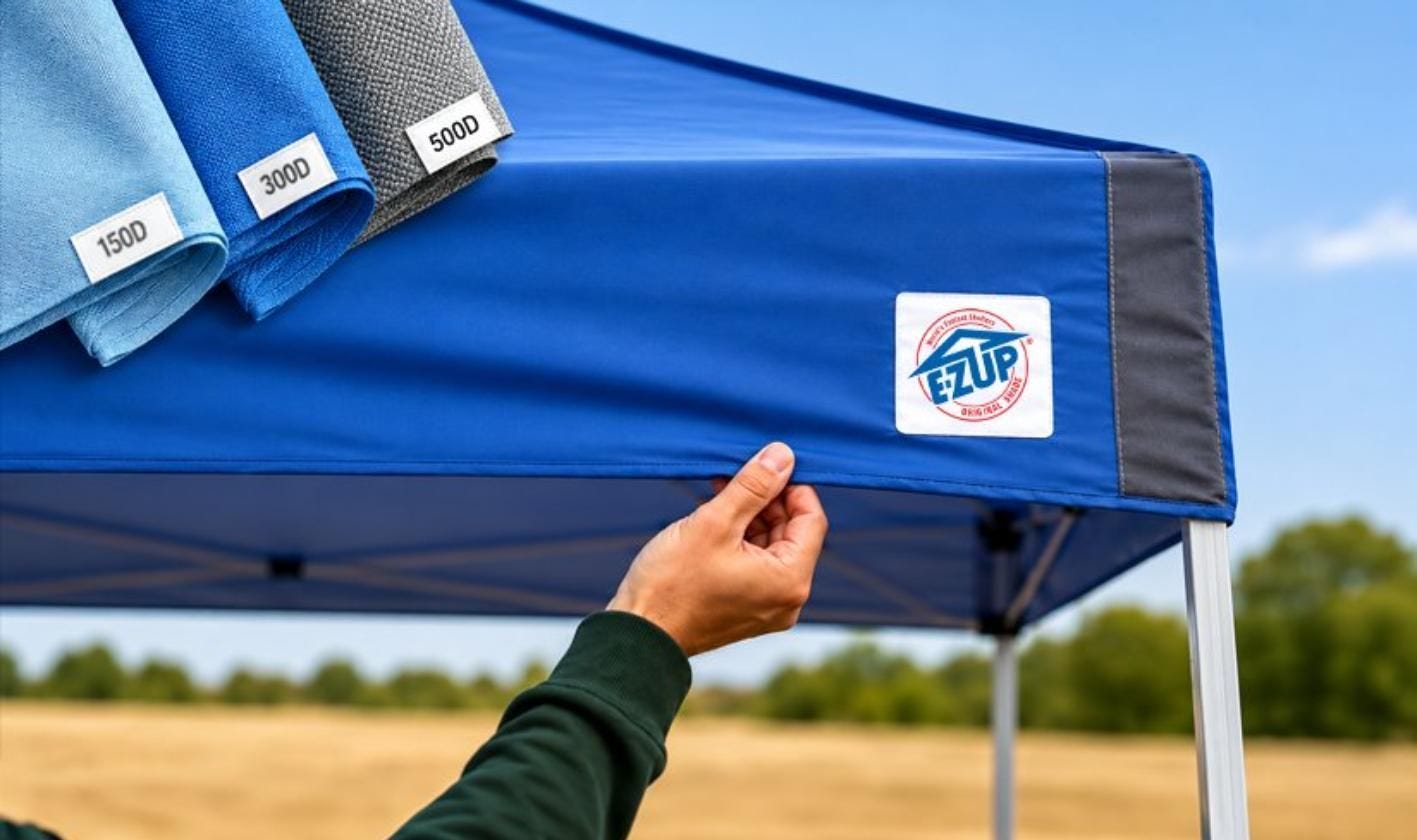
- 150D–300D - Lighter fabrics suited for occasional, lower-demand use. E-Z UP's medium-duty canopies use 300D, striking a strong balance of manageable weight and solid durability for light commercial use or frequent recreational setups.
- 500D - The professional-grade standard. This is the denier rating found on every E-Z UP heavy-duty canopy, and it's the industry benchmark for commercial use and custom printing.
- 600D+ - Common in the market, but heavier gauge doesn't reliably translate to better real-world performance than 500D. In most cases, you're paying a portability penalty without a meaningful durability gain.
500D hits the point most commercial buyers are actually looking for: real durability without sacrificing the portability that makes a pop-up canopy practical to transport and set up solo.
Is 500D Canopy Fabric Good for Real-World Use?
Yes, and here's a practical example of why it matters.
Picture a promotional marketing team running outdoor activations every weekend from April to October - setting up and breaking down the same tent 20 to 30 times a season, in wind, UV exposure, and occasional rain. A lighter 150D fabric might hold up for a handful of events, but repeated stress on seams and packing wear will show within a season.
A 500D polyester canopy is built to deliver multiple seasons of consistent performance under that same use pattern. The heavier weave resists micro-tears, holds its finish, and keeps printed graphics looking sharp far longer
For heavy duty canopy tents used in demanding conditions, 500D is simply the more reliable choice.
500D vs. 300D Canopy Fabric: What's the Real Difference?
The gap between 300D and 500D isn't just about weight. The structural difference shows up in several ways:
- Tear resistance - 500D fabric is significantly harder to puncture or rip under stress.
- Weather performance - Thicker yarns mean better resistance to UV breakdown and moisture absorption.
- Print quality - Custom printed graphics retain color and crispness longer on a 500D surface.
- Longevity - Under comparable use conditions, 500D consistently outperforms 300D for lifespan.
For anyone investing in custom canopy tents for branding or professional use, the upgrade from 300D to 500D is worth it. You're not just getting a heavier fabric, you're getting a tent that represents your brand at a higher level, event after event.
Built to Last: How E-Z UP Reinforces 500D Canopies
Denier rating is only part of the durability equation. E-Z UP's heavy-duty canopies add two additional layers of engineering:
- FDY (Fully Drawn Yarn) construction on digitally sublimated custom-printed products, which allows for deeper ink transfer, richer color saturation, and better fade resistance over time than standard printing methods.
- Double-layer fabric reinforcement at corner stress points on many models, adding extra durability exactly where canopies take the most wear during setup, takedown, and wind load.
Together, these details are why a 500D E-Z UP canopy holds up to conditions that would degrade a standard 500D fabric from another brand.
What Makes 500D the Best Choice for Custom Printing?
Canopy tents used for trade shows, events, and brand activations have one requirement above all others: they need to look good consistently.
Custom printing on branded canopy tents depends on the fabric being able to hold dye saturation evenly across a tight weave. 500D polyester delivers that. The surface is dense enough to produce vibrant, edge-to-edge graphics without bleed or distortion, a real issue with lighter fabrics that have more give in the weave.
For trade show canopy tents and commercial canopy tents where first impressions carry real weight, a 500D fabric ensures that the printing investment pays off visually.
What to Look for When Comparing Canopy Tent Fabrics
Beyond denier, a complete fabric evaluation should include:
- Coating type: Look for additional coatings that improve water resistance, UV protection, mold/mildew resistance, and flame retardant.
- Seam construction: Fully bound seams and anti-wicking thread can minimize water penetration at seams, while heat-bonded seam sealing tape can effectively eliminate water ingress at the seams.
- Reinforcement details: Look for double-layer or reinforced stitching at corners and stress points — small details that predict how the tent survives years of setup/takedown, not just one season..
- Portability needs: If your team is transporting the tent frequently, factor in the weight increase of 500D vs. lighter options.
Professional event tents and pop up canopy tents designed for frequent use are built around these specs working together, not just fabric weight in isolation.
The Bottom Line on Canopy Fabric Weight
Denier, not GSM, is the number that actually predicts how a canopy fabric performs outdoors. 500D polyester is the professional-grade benchmark: strong enough for demanding outdoor conditions, refined enough for high-quality custom printing, and balanced enough to stay practical for teams setting up and breaking down every week.
If you're investing in a canopy for business use, brand marketing, or any application where durability isn't optional, 500D is the standard to look for. It's the standard used across commercial canopy tents, outdoor event shelters, and custom printed tents for a reason: it delivers consistent performance where lighter fabrics start to fall short.
If you're investing in a canopy for business use, brand marketing, or any application where durability is non-negotiable, 500D is the gold standard.
Frequently Asked Questions
What does 500D mean on a canopy tent?
The "D" in 500D stands for denier, a measure of yarn thickness. A 500D rating means the individual fibers used in the fabric are heavy-gauge resulting in a stronger, more durable weave compared to lighter options like 300D. It's the Professional-grade standard used in commercial and heavy duty E-Z UP canopies designed for repeated outdoor use.
Is 500D canopy fabric good for outdoor use?
Yes. 500D polyester is one of the most reliable fabric choices for outdoor canopy tents. It resists tearing, handles UV exposure better than lighter materials, and maintains its shape and finish through repeated setup and breakdown cycles, making it well-suited for events, trade shows, and outdoor marketing activations.
Is 500D better than 300D canopy fabric?
500D offers greater strength, improved resistance to wear and weather, and sharper printed graphics. For frequent business or event use, 500D outperforms 300D over time. 300D remains a strong option for light commercial use or frequent recreational setups where weight and portability matter more.
What is the best fabric weight for a canopy tent?
For most commercial and custom-use applications, 500D polyester is the best balance of durability, performance, and portability — heavy enough for demanding outdoor conditions, manageable enough for teams setting up and breaking down frequently.
What's the difference between denier and GSM?
Denier measures the thickness of individual yarns in a fabric; GSM measures the overall fabric weight per unit area. Both relate to durability, but denier is the more commonly referenced and better-understood spec in the US canopy tent market.